
Global Travel Retail as a new frontier for spirits: between premiumization, territorial identity, and international consumers.
Airport duty-free shops, stores inside cruise ships, service stations along highways. Global Travel Retail is the sales channel that captures transactions occurring while the consumer is traveling. Yet, viewing Global Travel Retail as a simple distribution channel might be reductive: “It is also a touchpoint with an international consumer and an excellent tool for building identity and positioning.”
This is the perspective of Alessandro Palmarin, former founder of NIO COCKTAILS, now heading the consulting firm Nomad, a lecturer at the Università Cattolica, and an active player in the development of various beverage projects, such as Ve Nice and Æterna gins.
“I believe a fundamental starting point for a small, artisanal business is to develop an awareness as soon as possible that it cannot compete with the majors on classic products and traditional sales channels. Quality is not enough. What a company with these characteristics can do, however, is to select niches interested in a specific storytelling and use this as a lever to convince consumers to make a purchase.”
In 2025, global airports handled approximately 9.8 billion passengers and, according to ACI World, this traffic is expected to exceed 10 billion in 2026. In travel retail, according to IWSR, spirits grew by 6% in volume and 7% in value in 2025. The 2025 Global Shopping Monitor by DFWC and m1nd-set also reveals that 64% of duty-free shoppers look for exclusive or unique products.
Therefore, GTR does not just coincide with the logic of duty-free understood as a place for discounts. There is a convenience component, but also a segment where the product is purchased for the experience, exclusivity, as a gift, or as a memory of the trip. This is where, according to Palmarin, an artisanal producer can find space: one does not compete on price, but designs something that has a precise reason to be in that specific place.
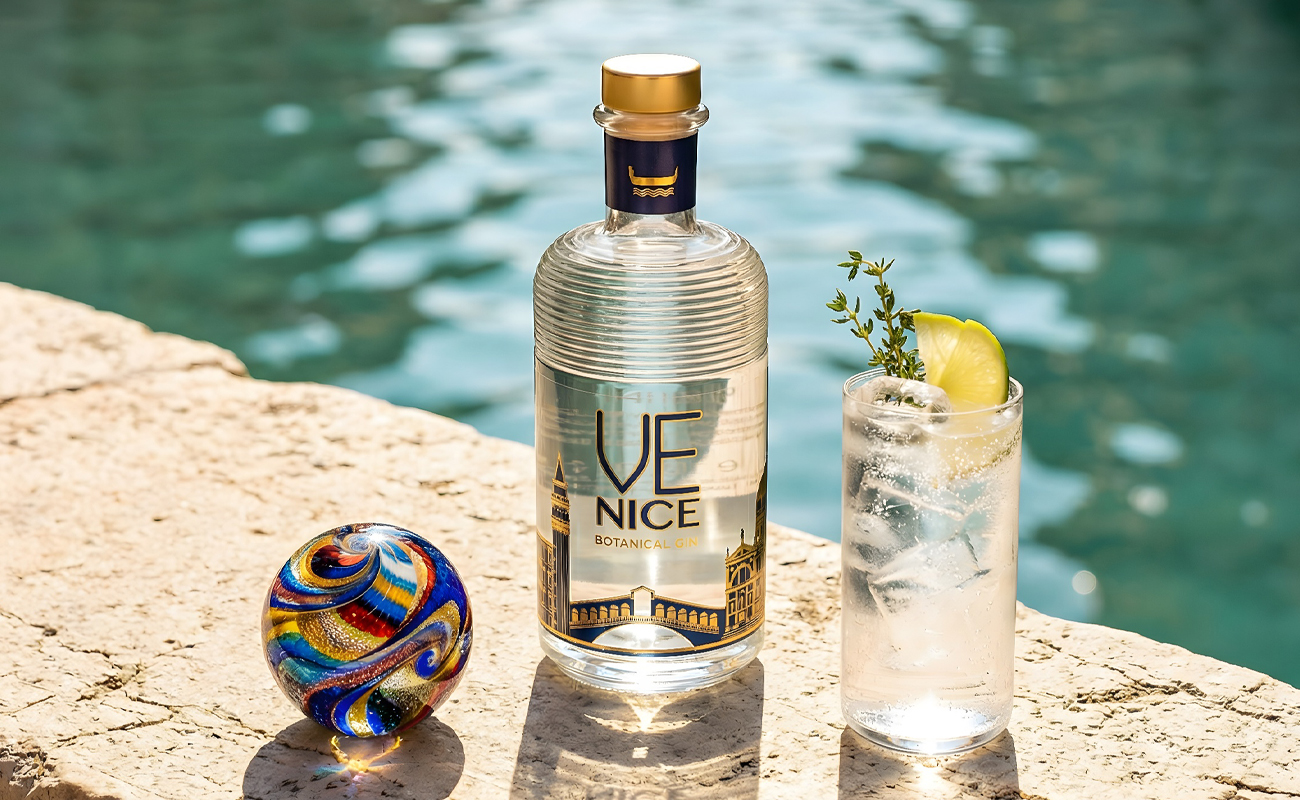
“During a trip, whether for pleasure or work, a person is generally more inclined to evaluate new options and seek something exclusive. The VE NICE gin was born from a request from the Venetian airport retail sector: they needed a product that told the story of Venice with sincerity, but which could also be quickly decoded by an international traveler through its name, bottle, and label.”
The chosen recipe plays around the geography and history of the city. Venice beneath the Alps and Venice as a gateway to the spices of the East: alpine juniper, lemon verbena, rosemary, bay leaf, mint, and black pepper.
“We didn’t want to make a banal souvenir of the city, but create a spirit that could maintain a purpose even outside the airport. A product that becomes, in the journey, a memory of the place itself.
ÆTERNA, on the other hand, was born through licensing with AS Roma and uses a symbolic heritage already recognizable on an international level. However, to avoid mere merchandising, we added an extra layer: the bottle and references to the city attract the attention of the fan and the traveler; in parallel, the recipe supports the proposal and expectations.
Sportswear is now part of contemporary fashion and lifestyle; we target both the fan and the casual traveler, offering a product that aims to establish itself as the reference gin for the entire capital city.”
The stated goal is, in short, to bring ÆTERNA outside of travel retail and into the city, through bars, hotels, and distribution. A strategy that shows how GTR can also be the first step of a broader project: using airport international traffic to build recognition and then bringing it back into the local market.
“From October, Patrick Pistolesi of Drink Kong will be the Strategic Ambassador & Cultural Partner for ÆTERNA; until today, he had never tied himself to any product, and the fact that he accepted our proposal makes us particularly proud. Over the next twelve months, we want to conquer the city!”
For an Italian producer, the GTR can effectively be a sort of “domestic” export. In the first seven months of 2026, Italian airports recorded 137.4 million passengers, 94.3 million of whom were international. Venice exceeded 7.3 million passengers, and Fiumicino 29.5 million. A small company can, therefore, meet foreign consumers without yet having established distribution in their home countries.
It is not, however, a shortcut. Space, requirements, logistics, and entry costs make the channel complex. For Palmarin, the return should not be measured only at the cash register: a qualified presence at the airport can help build credibility with distributors, buyers, and consumers.
The key, however, remains design: in the GTR, the territory must not be a decoration applied to the bottle, it must become part of the product: immediate enough to be understood in a few seconds and authentic enough to continue working even when the travel experience has concluded.